Looking Through an Atomistic Lens
1. Introduction: The Microscopic Origins of Macroscopic Worlds
As engineers and scientists, we spend much of our time observing the macroscopic world. We measure the stress of a steel beam, the viscosity of a fluid in a pipe, or the temperature of a gas in a turbine. These are “observable” properties—tangible, measurable realities that dictate how we build bridges or design engines.
But why does steel hold its shape while water flows? Why does a gas expand to fill a container while a solid resists compression?
To answer these questions, we cannot simply look at the material; we must look inside it. We must bridge the gap between the visible world of continuum mechanics and the invisible world of atomistic interactions.
To understand how materials behave, we must first revisit our understanding of their fundamental constituents: atoms.
2. The Building Blocks of Matter
It is a scientific truism that “everything is made of atoms.” You likely memorized the Periodic Table in high school, viewing it as a catalog of the universe’s ingredients. However, for molecular simulation, we need to move beyond viewing atoms as mere labels. We must understand them as physical entities with mass, volume, and internal structure.
An atom is not a solid, indivisible sphere. It is a composite structure made of three subatomic particles:
Protons (): Positively charged and heavy. They reside in the nucleus.
Neutrons (): Neutral and heavy. They glue the nucleus together.
Electrons (): Negatively charged and incredibly light (approximately 1/1836 the mass of a proton).
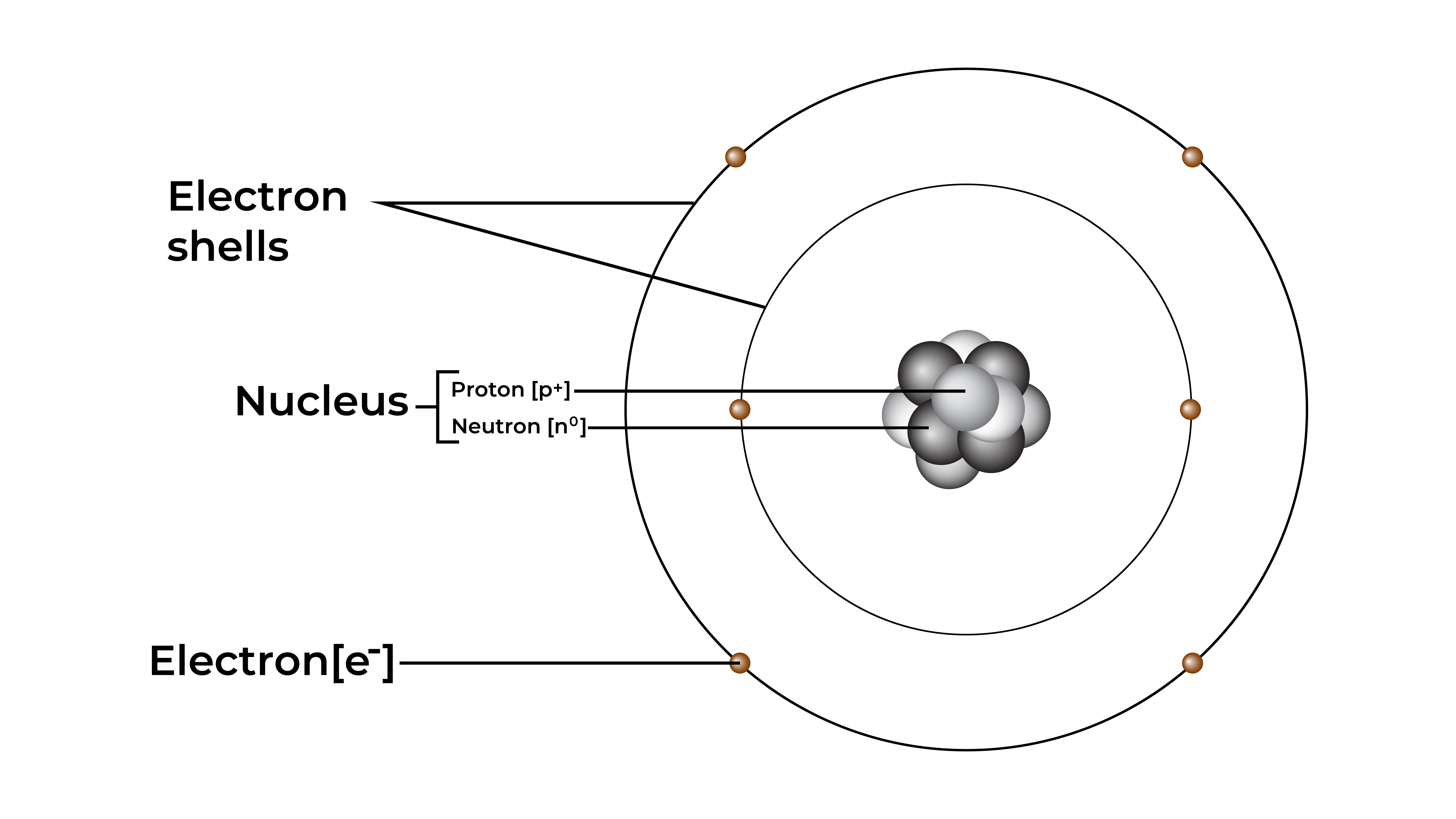
The Architecture of the Atom
The arrangement of these particles is striking. Protons and neutrons bundle tightly in the center, forming the nucleus. This core contains over 99.9% of the atom’s mass but occupies a negligible fraction of its volume. If an atom were the size of a football stadium, the nucleus would be a marble on the 50-yard line.
The rest of the stadium—the vast, empty space surrounding that marble—is the domain of the electrons.
3. The Dynamic Electron
In classical physics, we often picture electrons orbiting the nucleus like planets orbiting the sun (the Bohr Model). While useful for simple calculations, this picture is misleading. Electrons do not travel in fixed, 2D circular tracks.
Instead, electrons exist in orbitals—three-dimensional regions of space where an electron is statistically likely to be found. These electrons are in constant, frantic motion, buzzing around the nucleus at significant fractions of the speed of light.
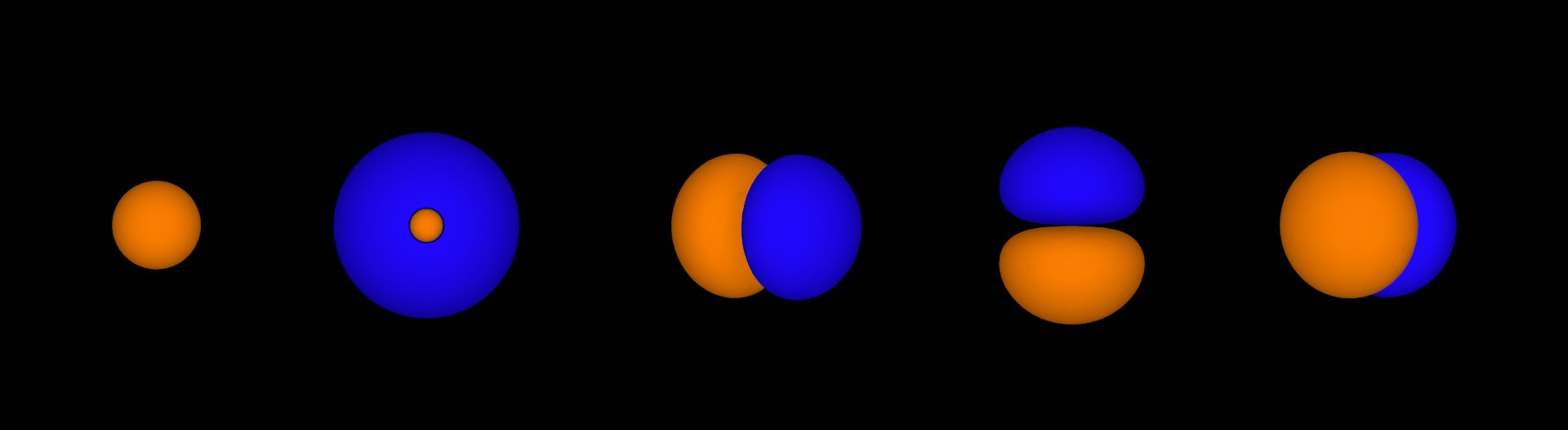
Why do we care about electrons?
In this course, we will often treat atoms as single particles (like billiard balls) to save computational cost. However, we must never forget that electrons are the agents of interaction.
The Nucleus provides the mass (inertia).
The Electrons provide the chemistry (forces).
When two atoms approach each other, their nuclei never touch. It is their electron clouds that interact, repel, or bond. The specific arrangement of these electrons determines whether two atoms will snap together to form a molecule or bounce off one another.
4. A Tale of Two Materials: Hydrogen vs. Iron
To truly appreciate the “Atomistic View,” let us compare two materials composed of a single element. Macroscopically, they could not be more different.
Hydrogen Gas (): A gas at room temperature. It is light, invisible, and expands to fill any volume.
Iron (): A solid metal. It is heavy, shiny, conductive, and rigid.
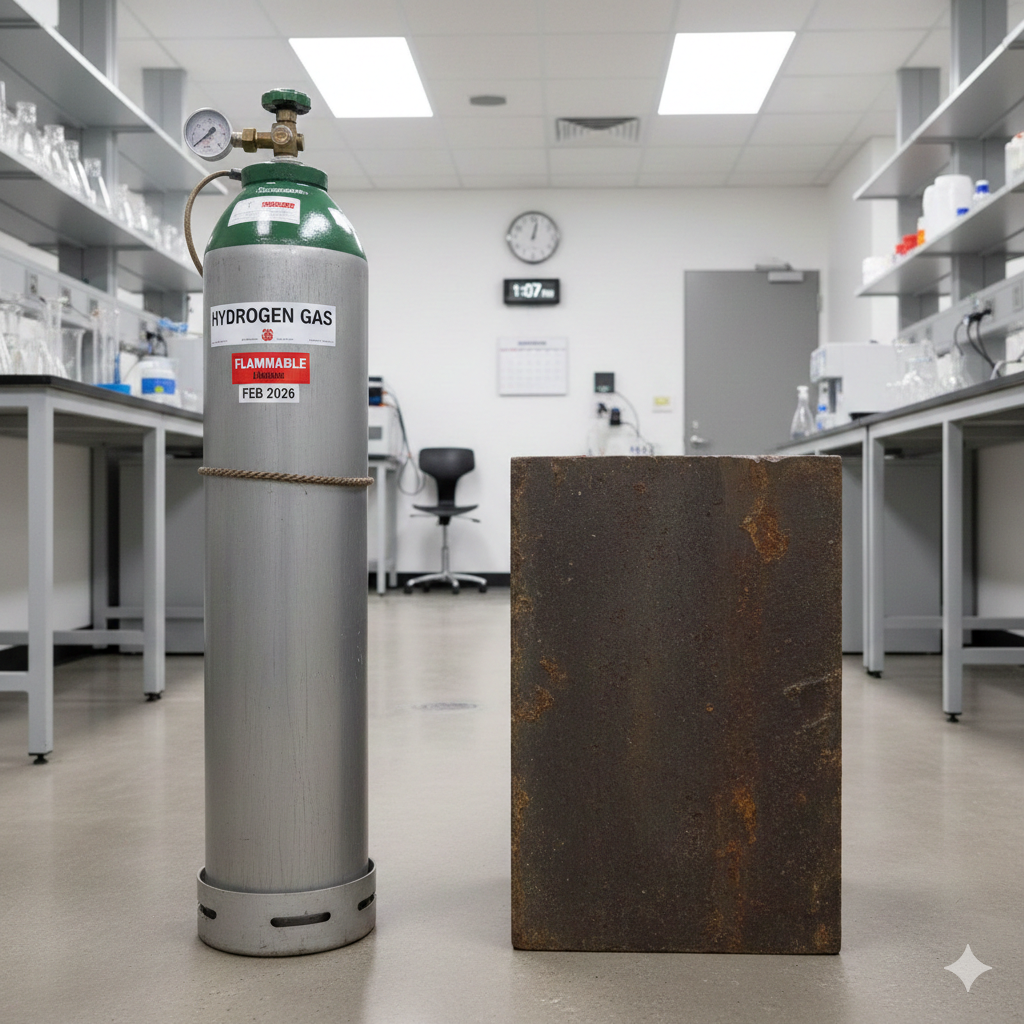
Figure 1:Comparison of a hydrogen gas cylinder next to an iron block.
Both are made of atoms. Both have protons, neutrons, and electrons. Why is one a chaotic gas and the other a rigid solid? The answer lies in structure and motion.
Zooming into Hydrogen ()
If we were to look at hydrogen gas under a powerful microscope, we would see chaos.
Structure: Hydrogen atoms are uncomfortable being alone. They pair up tightly to form diatomic molecules ().
Motion: These molecules are flying through space at incredible speeds (approx. 1700 m/s at room temperature).
Interaction: The molecules are far apart. They ignore each other until they collide, bouncing off like billiard balls.

Figure 2:Simulated motion in hydrogen gas at 300K for 10 fs.
Zooming into Iron ()
If we look at the iron block, we see order.
Structure: Iron atoms pack together in a highly organized, repeating geometric pattern known as a Crystal Lattice. In this state, every atom shares electrons with its neighbors, creating a “glue” that holds the structure together.
Motion: Are these atoms still? No. Even in a solid block of steel, the atoms are vibrating furiously. They are trapped in their lattice sites, shaking back and forth, but they generally do not leave their assigned spots.
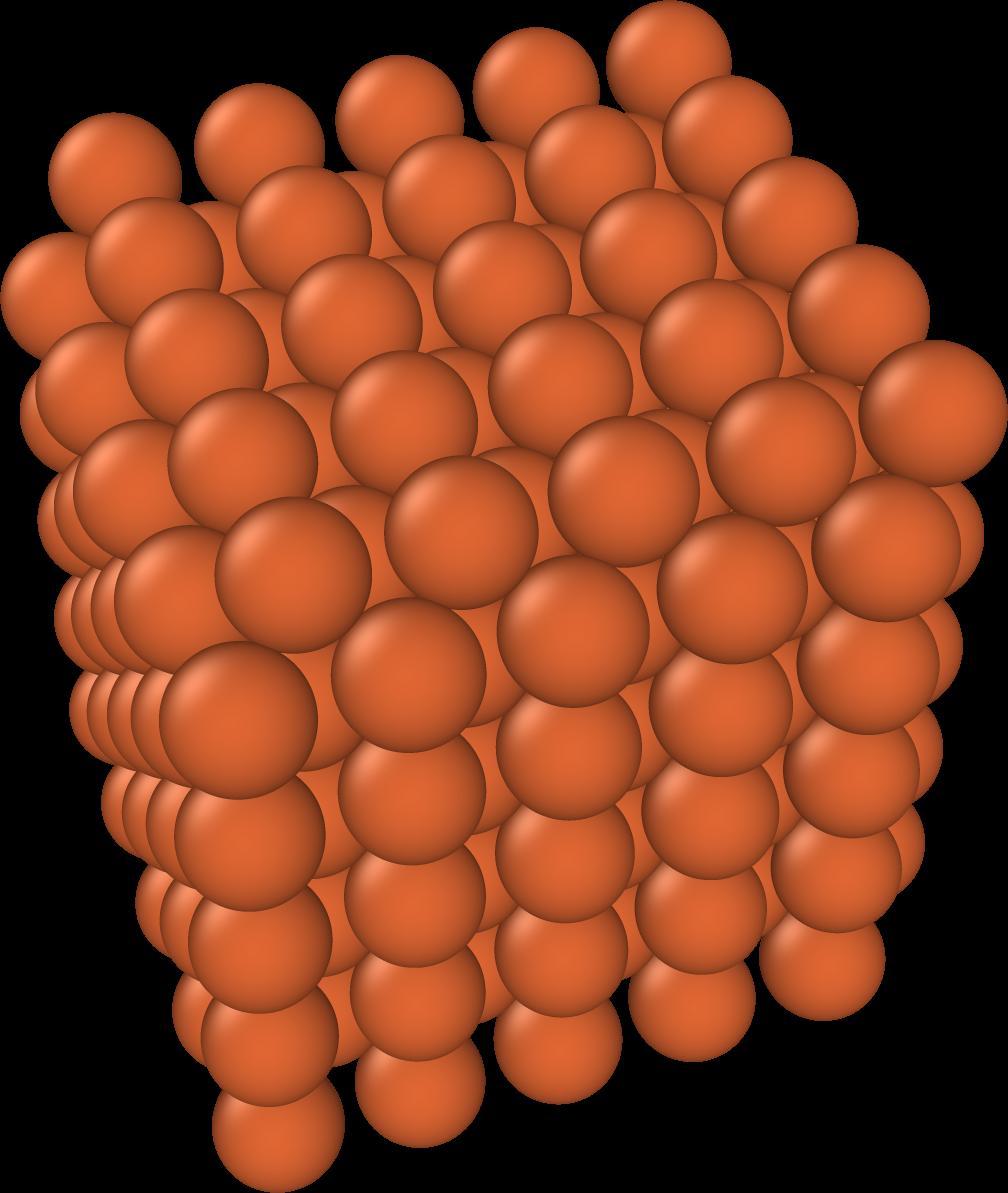
Figure 3:The Body-Centered Cubic (BCC) crystal lattice structure of Iron. Note the highly ordered, repeating arrangement of atoms that characterizes metallic bonding.
5. The Universal Truth: Atoms are Always in Motion
This comparison leads us to the fundamental concept of Statistical Mechanics: Matter is motion.
The only difference between the “flying” hydrogen molecules and the “shaking” iron atoms is the balance of forces.
Gas Phase: The kinetic energy (motion) is so high that it overcomes the attractive forces between molecules. The particles fly free.
Solid Phase: The attractive forces are strong enough to trap the atoms. The kinetic energy manifests as vibration, not flight.
In the chapters that follow, we will learn how to simulate this motion. We will calculate the forces that hold the iron together and the collisions that determine the pressure of the hydrogen gas. By understanding the dance of the atoms, we unlock the ability to predict the properties of the material.
6. The Nature of Chemical Bonding
In both our Hydrogen and Iron examples, the atoms were not isolated. The Hydrogen atoms paired up to form diatomic molecules (), and the Iron atoms arranged themselves into a vast, repetitive crystal lattice. In both cases, the atoms chose to stick together rather than drift apart.
Why do atoms bond?
The answer is fundamentally thermodynamic: Nature seeks the lowest energy state.
Imagine a ball at the top of a hill. It is unstable; a slight nudge will send it rolling down. The ball “wants” to be at the bottom of the valley, where its potential energy is lowest. Atoms behave similarly.
High Energy (Unstable): Two isolated atoms far apart often have higher potential energy.
Low Energy (Stable): When they come close and share or exchange electrons, they fall into an “energy well.”
Different materials form different types of bonds to achieve this low-energy state. We generally categorize them into four types.
A. Covalent Bonds: The “Shared” Bond
This is the most common bond in organic chemistry and the primary focus when simulating biological molecules (proteins, DNA) or polymers.
Mechanism: Two atoms “share” a pair of electrons. Neither atom is strong enough to steal the electron from the other, so they cooperate to fill their outer electron shells.
Characteristics: These bonds are strong, stable, and highly directional. A carbon atom doesn’t just bond to anything nearby; it bonds at specific angles (e.g., the tetrahedral angle in methane).
Analogy: Two people holding hands. To move apart, they must let go (break the bond).
Examples: Hydrogen gas (), Carbon-Carbon bonds in plastics ().

B. Ionic Bonds: The “Stolen” Bond
While covalent bonds involve sharing, ionic bonds involve theft. This occurs between atoms with vastly different affinities for electrons (electronegativity).
Mechanism: One atom (the thief) completely strips an electron from another. This creates a positive ion (cation) and a negative ion (anion). Since opposites attract, these ions snap together via electrostatic force (Coulomb’s Law).
Characteristics: These bonds are non-directional. A positive ion attracts all nearby negative ions equally in every direction. This typically forms brittle crystals.
Analogy: Two magnets snapping together.
Examples: Table salt (), where Chlorine steals an electron from Sodium.

C. Metallic Bonds: The “Communal” Bond
This explains the structure of our Iron () block.
Mechanism: Metal atoms are generous. They loosely hold their outer electrons and allow them to drift freely throughout the entire material. This creates a grid of positive ion cores floating in a “sea of electrons.”
Characteristics: Because the electrons are free to move, metals conduct electricity. Because the atoms are swimming in a generic “glue” rather than locked into specific angle bonds, metals are malleable (you can dent iron without shattering it).
Examples: Iron, Copper, Gold.

D. Hydrogen Bonds
Strictly speaking, this is an intermolecular force rather than a permanent bond, but it is so strong and vital for life that we treat it with special care in simulations.
Mechanism: In molecules like water (), the oxygen acts like a bully, hogging the shared electrons. This makes the oxygen slightly negative and the hydrogen slightly positive. This positive hydrogen is then attracted to the negative oxygen of a neighboring water molecule.
Characteristics: These bonds are much weaker than covalent bonds (about 1/20th the strength) and are constantly breaking and reforming. However, they are responsible for water being a liquid and for holding DNA strands together.
Examples: Liquid water, DNA double helix, protein folding.

Summary of Bond Strengths
As molecular simulators, we need numbers. “Strong” and “weak” are not enough; we need to know how much energy is required to break a specific interaction so we can define our force fields.
The table below compares the typical bond strengths. Note the massive difference between the “permanent” chemical bonds and the “intermolecular” forces.
| Bond Type | Mechanism | Typical Strength (kcal/mol) | Example |
|---|---|---|---|
| Covalent | Shared electrons | 50 – 200 | C–C bond in Diamond (83 kcal/mol) |
| Ionic | Electrostatic attraction | 150 – 400 (Lattice Energy) | NaCl Crystal (183 kcal/mol) |
| Metallic | Sea of electrons | 25 – 200 | Iron (Fe) (100 kcal/mol) |
| Hydrogen | Dipole attraction | 1 – 10 | Water dimer () (~5 kcal/mol) |
| Van der Waals | Induced fluctuations | < 1 | Argon gas, Methane interactions |
7. Beyond Simple Solids: Complex Materials
So far, we have looked at simple extremes: Iron (an ordered 3D crystal) and Hydrogen (a disordered gas). However, many of the materials you will study in this class—and encounter in the real world—lie somewhere in between.
Let’s explore two classes of materials that demonstrate how the arrangement of atoms is just as important as the type of atoms.
A. Polymers: The Molecular Spaghetti
Polymers are the backbone of modern materials science (plastics, rubber, biomolecules). The word comes from Greek: poly (many) and mer (parts).
Consider Polyethylene, the most common plastic in the world (used in grocery bags and shampoo bottles).
Composition: It is chemically very simple—just Carbon and Hydrogen.
Structure: Instead of forming a compact crystal like Iron, the carbon atoms link together in extremely long chains, often thousands of atoms long.
The “Dual” Nature:
Inside the Chain: The atoms are held together by super-strong Covalent Bonds (). These chains are almost unbreakable under normal use.
Between Chains: The chains interact with neighbors only through weak Van der Waals forces.
Why does this matter? Think of a bowl of cooked spaghetti. The individual noodles are strong (the covalent chains), but they are tangled up. You can pull a noodle out (slide the chains past each other) because the friction between them is low. This “entanglement” gives polymers their unique viscoelastic properties—they can stretch like rubber or flow like a liquid depending on temperature.

B. Carbon: The Ultimate Shape-Shifter
There is no better example of “Structure Determines Property” than Carbon. Pure carbon can exist in vastly different forms (allotropes) depending entirely on how the atoms bond to their neighbors.
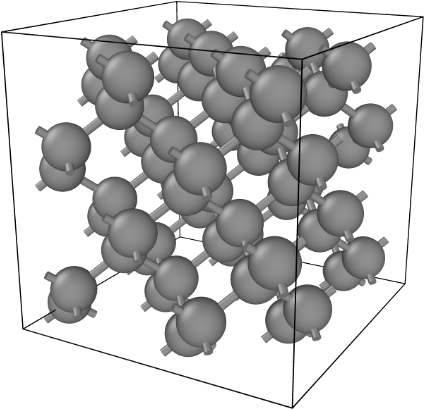
1. Diamond
Structure: Every carbon atom is covalently bonded to four other carbon atoms in a perfect tetrahedral pyramid. This creates a rigid, 3D interlocking network.
Properties: It is the hardest natural material and an electrical insulator.
Simulation Note: To simulate diamond, your force field must rigidly enforce these angles.
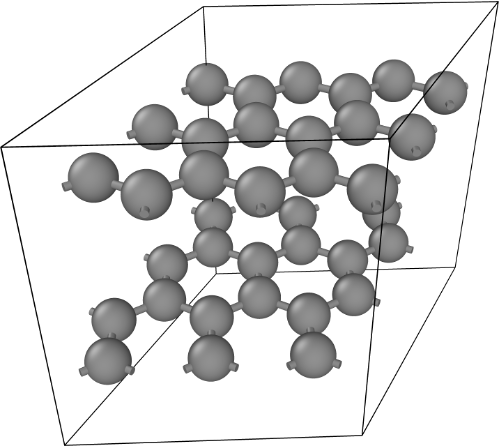
2. Graphite (and Carbon Black)
Structure: Every carbon atom bonds to only three neighbors. They form flat, hexagonal sheets (like chicken wire).
Properties:
In-Plane: The bonds are incredibly strong.
Out-of-Plane: The sheets are not bonded to each other; they just stack loosely. This allows the sheets to slide over one another effortlessly. This is why graphite is used as a lubricant and as “lead” in pencils (you are shearing off sheets of carbon onto the paper).
Carbon Black: This is essentially “messy graphite”—small, unordered chunks of these sheets. It is used to reinforce tires and make black ink.
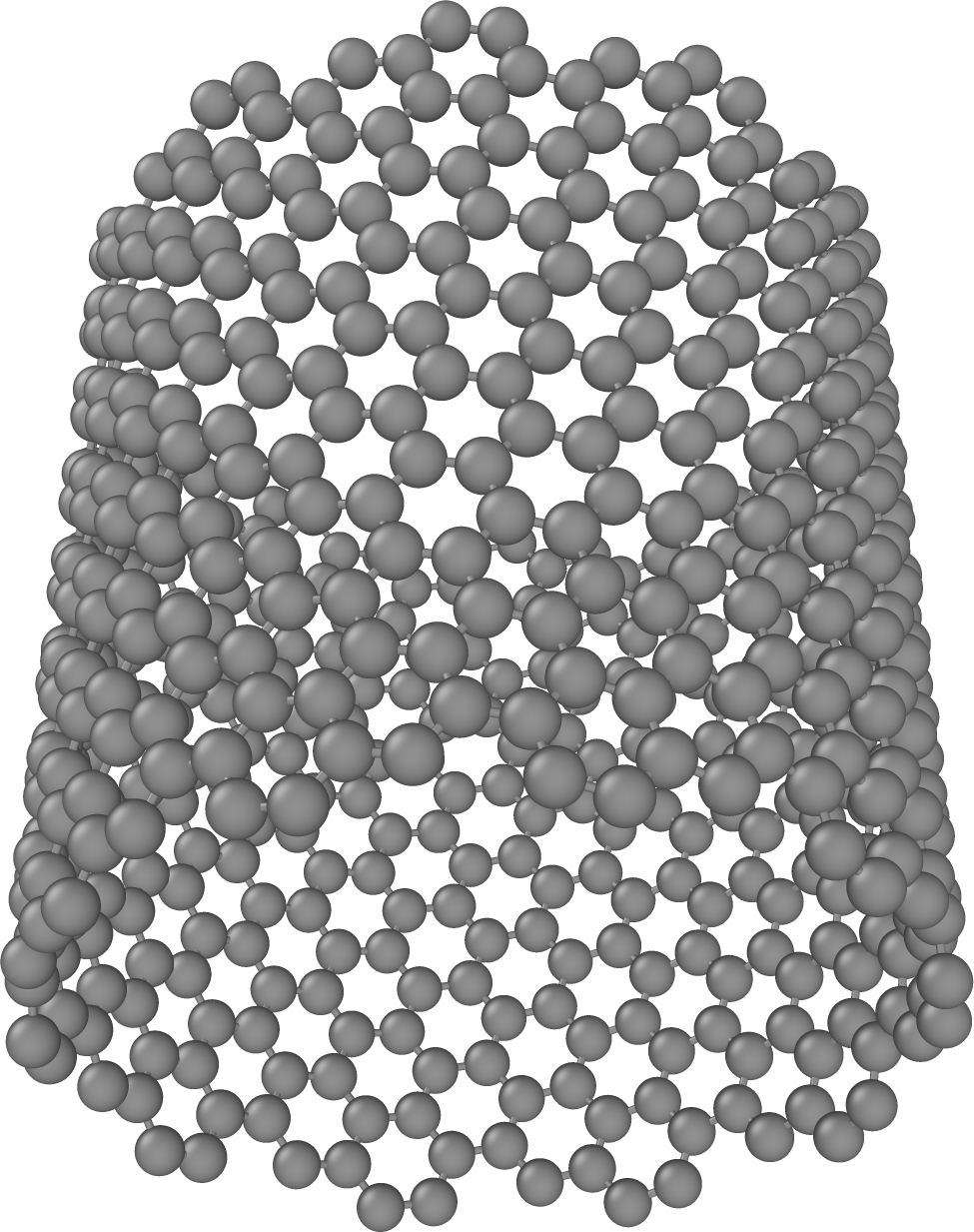
3. Carbon Nanotubes (CNTs)
Structure: Imagine taking a single sheet of graphite (graphene) and rolling it into a seamless tube.
Properties: These are among the strongest materials ever discovered. Because the carbon bonds are oriented along the length of the tube, they have immense tensile strength.
Application: CNTs are the “poster child” of nanotechnology, used in conductive composites, battery electrodes, and next-gen electronics.
8. Further Reading & Resources
To master the atomic perspective, it helps to see it in action. Here are selected resources to deepen your understanding of the concepts covered in this chapter.
🖥️ Interactive Simulations (Highly Recommended)
Nothing beats playing with the physics yourself. These free simulations from PhET (University of Colorado) allow you to visualize the forces we discussed.
States of Matter: Heat up Neon, Argon, and Water to see the transition from solid to liquid to gas. Watch how the atoms vibrate before breaking free.
Atomic Interactions: A simple playground to drag two atoms apart and see the Potential Energy curve (the “well”) in real-time.
Molecule Shapes: Build your own molecules and see how electron pairs force bonds into specific angles (like the in Diamond).
📖 Open Textbooks (LibreTexts)
Atomic Structure & Orbitals: A detailed dive into quantum numbers and electron configurations.
Chemical Bonding: Comprehensive notes on Ionic, Covalent, and Metallic bonding models.